Seesaws
Play Equipment
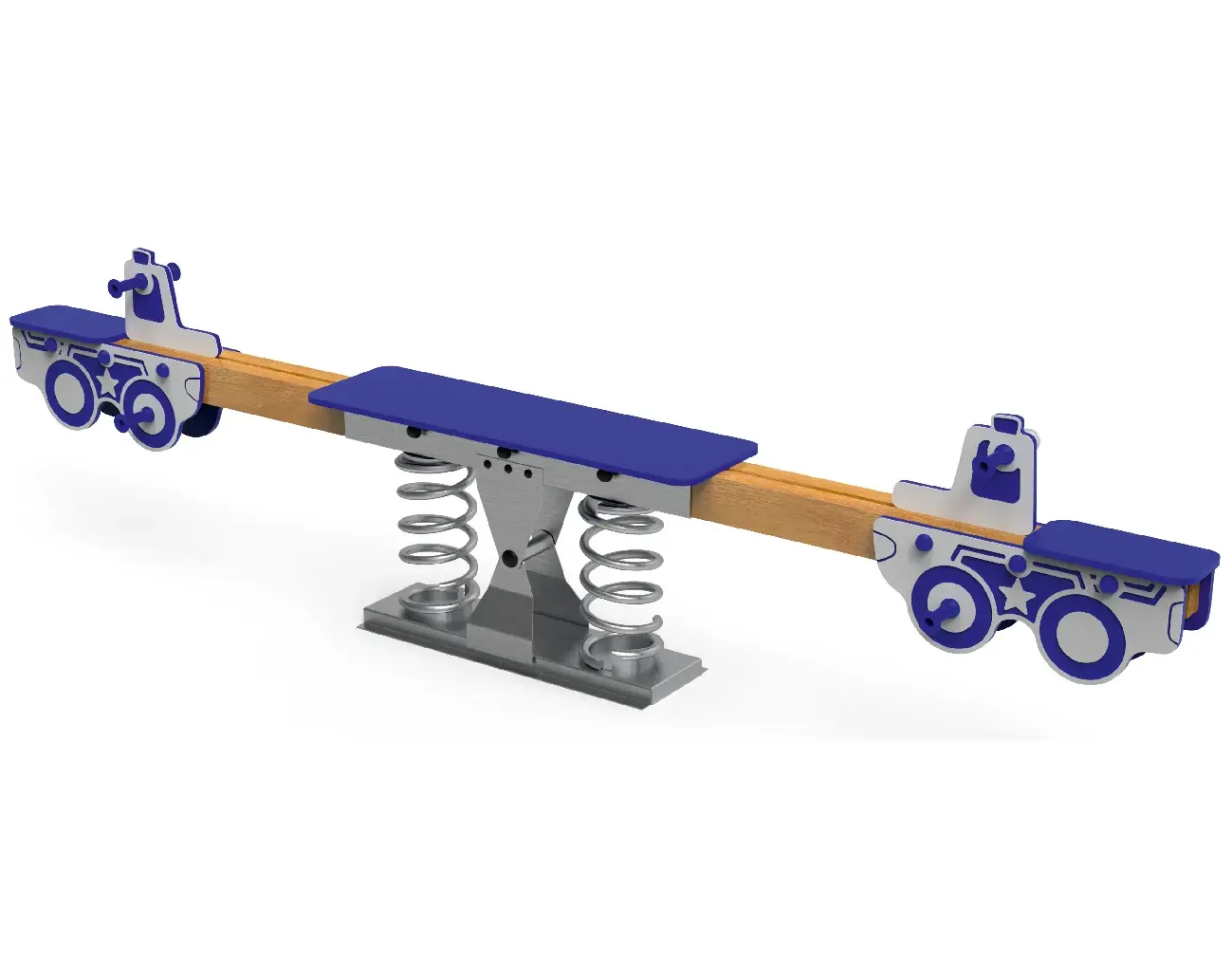
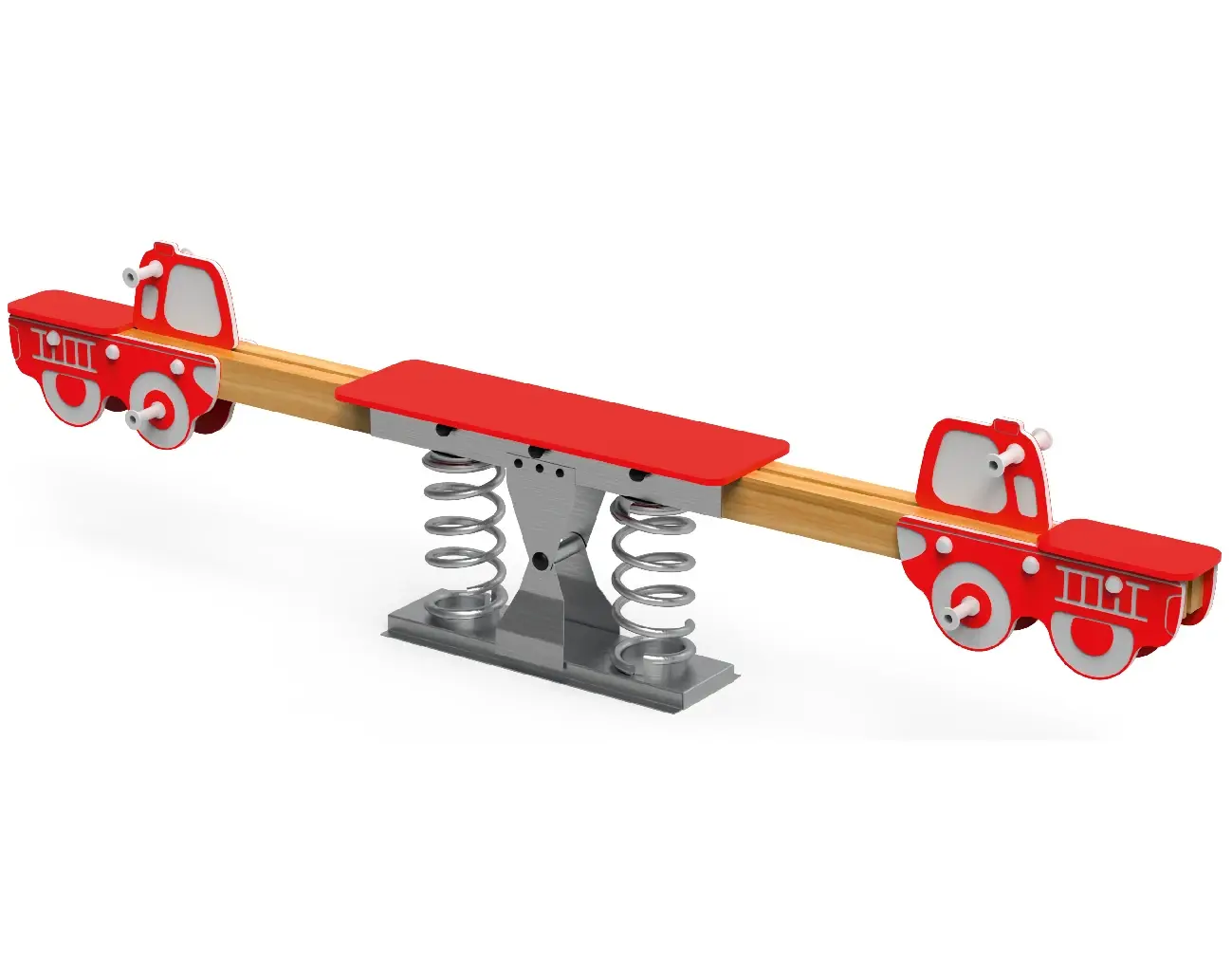
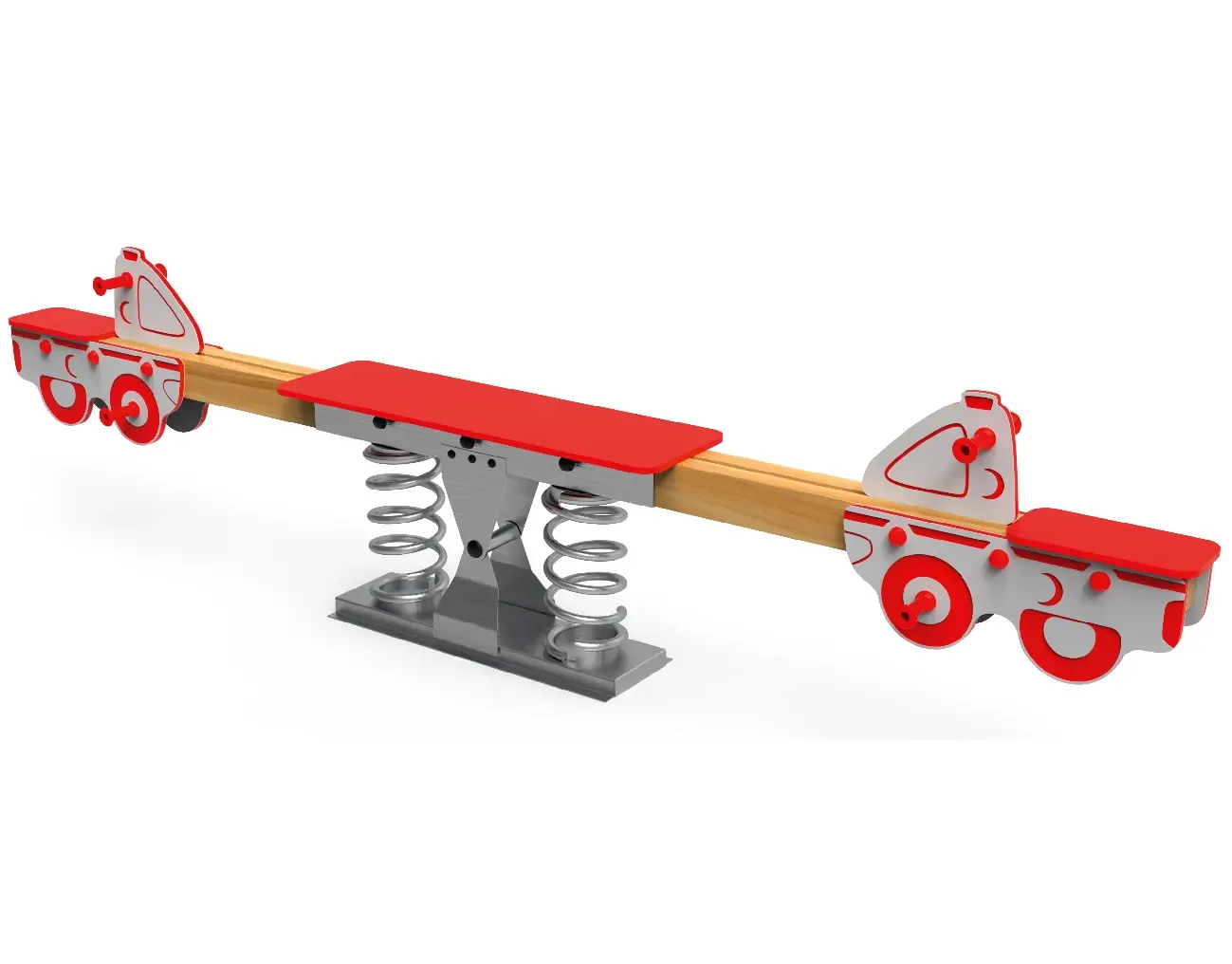
Two- and four-seat seesaws in spring-based and classic pivot versions.
The seesaw is the classic park item on which two or four children balance against each other. The catalogue holds 3 models; body and arms are electrostatically powder-coated steel, with seats and grips sized for children. Two-seat models carry two arms on a single pivot, while four-seat models arrange four arms crosswise.
Its place in a play area comes from working a different skill to a swing or slide. On a seesaw the movement is produced not by the child but by the person opposite, so each has to reckon with their own weight, the other's weight and the timing between them. It is a simple but effective way of learning to share a task that cannot be done alone. Four-seat models serve more children at once and so cut queuing in busy areas.
There are two base types, and the choice turns on this. On classic pivot models the arm works directly on the joint and the landing can be hard. On spring-based versions a spring at each arm end damps the downward movement, which both reduces impact and softens the sudden drop when a child loses control. In areas used by younger children, spring-based models are preferred.
The age range is roughly 3 to 8. A child needs to sit balanced and hold the grip. Where two children differ noticeably in weight the motion stays one-sided; that is the nature of the equipment rather than a fault, but installing more than one unit and considering four-seat models reduces the problem in practice.
In siting, a seesaw's safety area extends along the axis the arms travel and stays narrow to the sides. The unit is therefore positioned with that axis parallel to pedestrian flow, and nothing — bench, kerb, tree or other equipment — is placed in front of where the arms come down. On four-seat models the area extends in four directions at once, so these need a more open position.
The impact-absorbing surfacing beneath is planned around the highest point of the arm and must be continuous enough to include the landing points. On classic pivot models the surfacing wears faster where the arm lands hard, so these spots need regular attention. The equipment sits under TS EN 1176 and the surfacing beneath it under TS EN 1177. Dimensions for these models are not held on the catalogue pages; we measure on site during the survey and confirm them in writing.
How many units a site needs follows directly from the seesaw being a two-person item. A single two-seat unit serves exactly two children at a time; the rest queue, and as the wait lengthens the equipment starts being used in ways it was not meant for. In busy school and neighbourhood settings, two two-seat units or one four-seat model work markedly better than a single two-seat one — an easy choice to accommodate in most projects, given how small and inexpensive the equipment is.
In terms of area, a seesaw asks for far less space than a playground set, which makes it one of the first standalone items added alongside a set in a narrow garden. Even so, the clearance along the axis the arms travel should not be underestimated: what counts is the total span between the two landing points, not the length of the unit itself.
Installation requires anchoring into a concrete foundation; the central body transfers the entire load to the ground, so the adequacy of that foundation is decisive. In maintenance the key point is the central pivot: increasing noise, play or resistance in movement all indicate wear. Alongside that, grip tightness, seat integrity, spring condition on sprung models and the presence of protective bolt caps are checked monthly. Share your site plan and we will settle on the right model and position.
We would like to use analytics cookies to understand how the site is used. The site works the same if you decline. Details