Playground Sets
Survivor Climbing Courses
Climbing courses built from ropes, nets and balance elements — physically demanding, aimed at older children and teenagers.
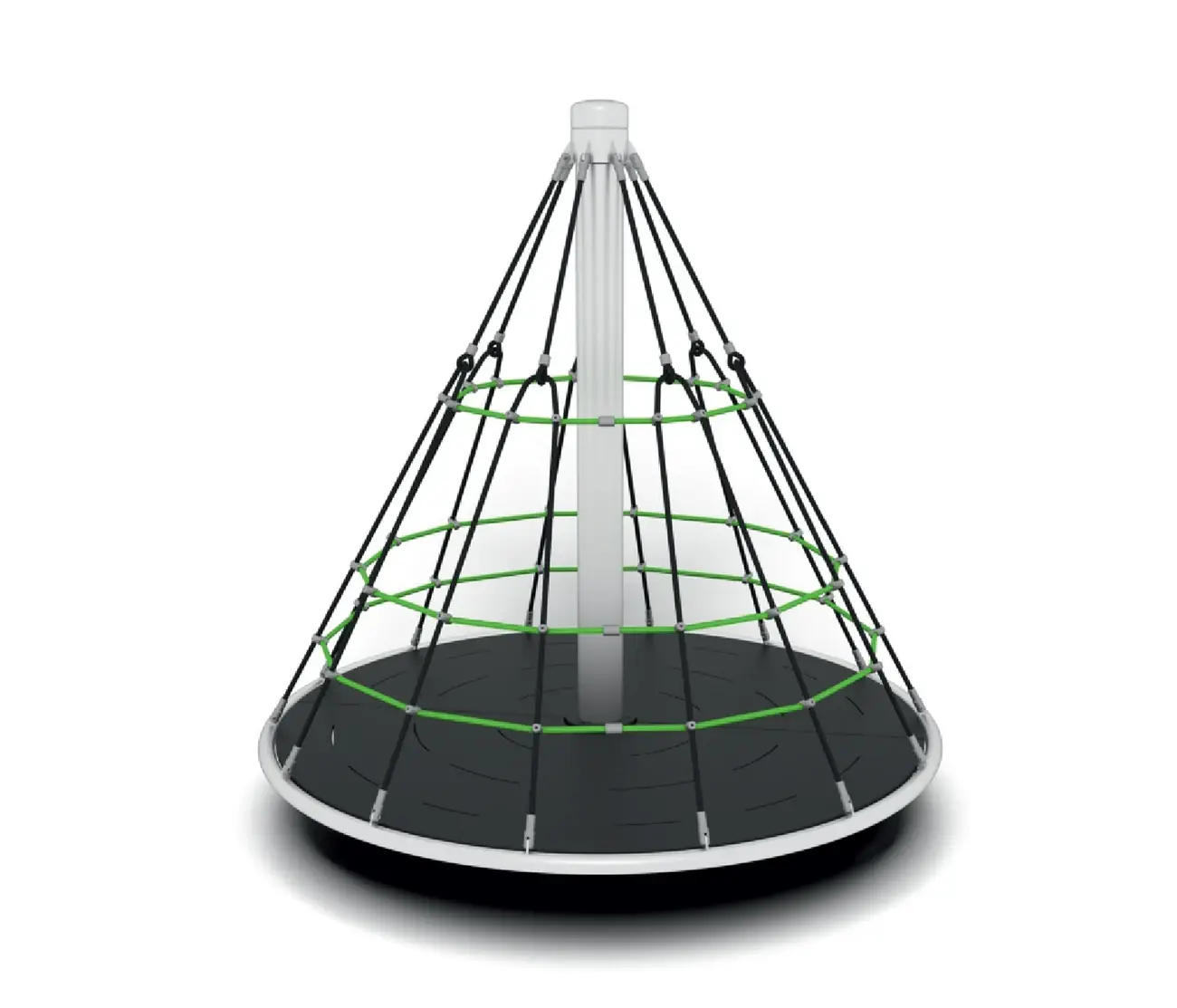
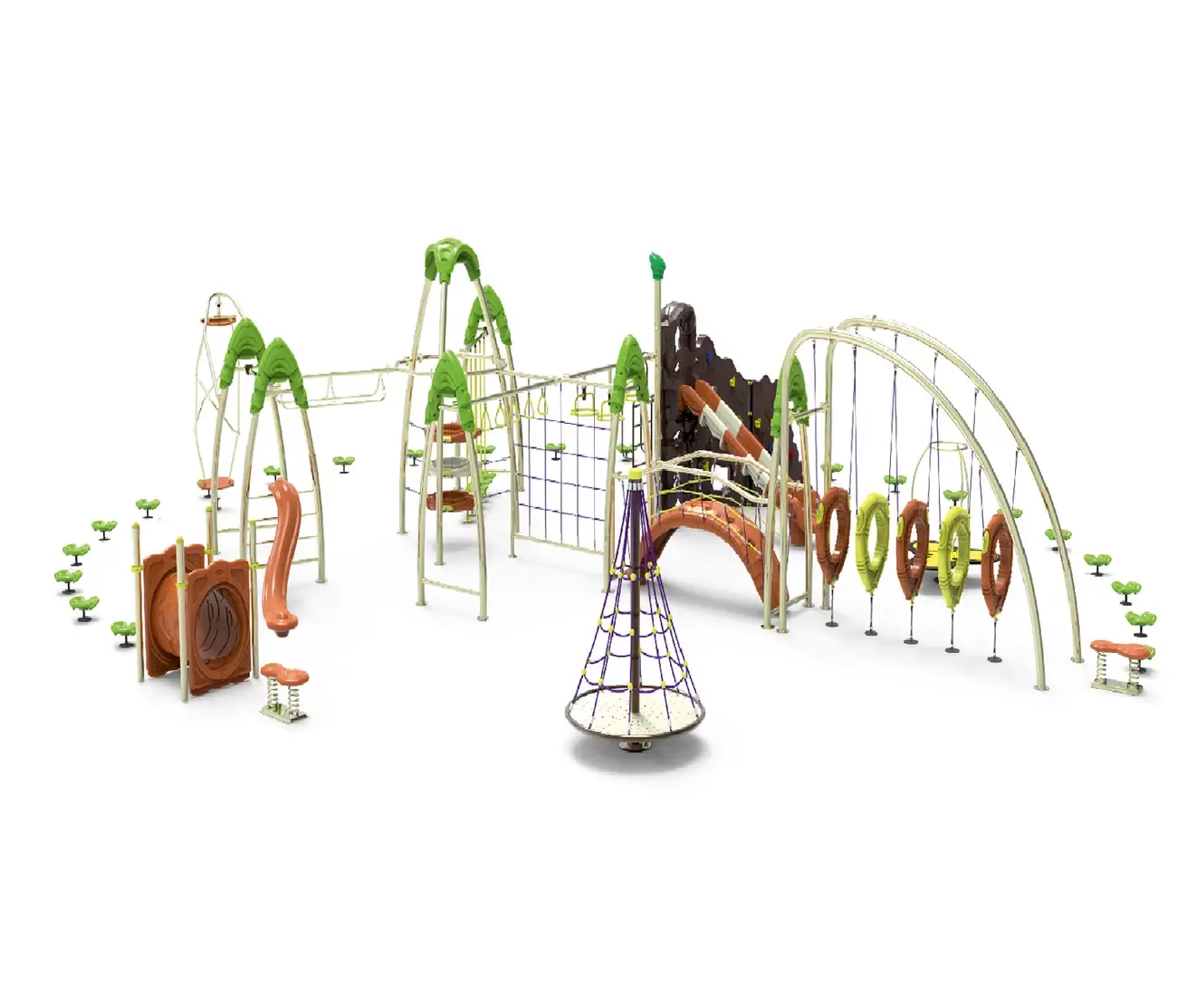
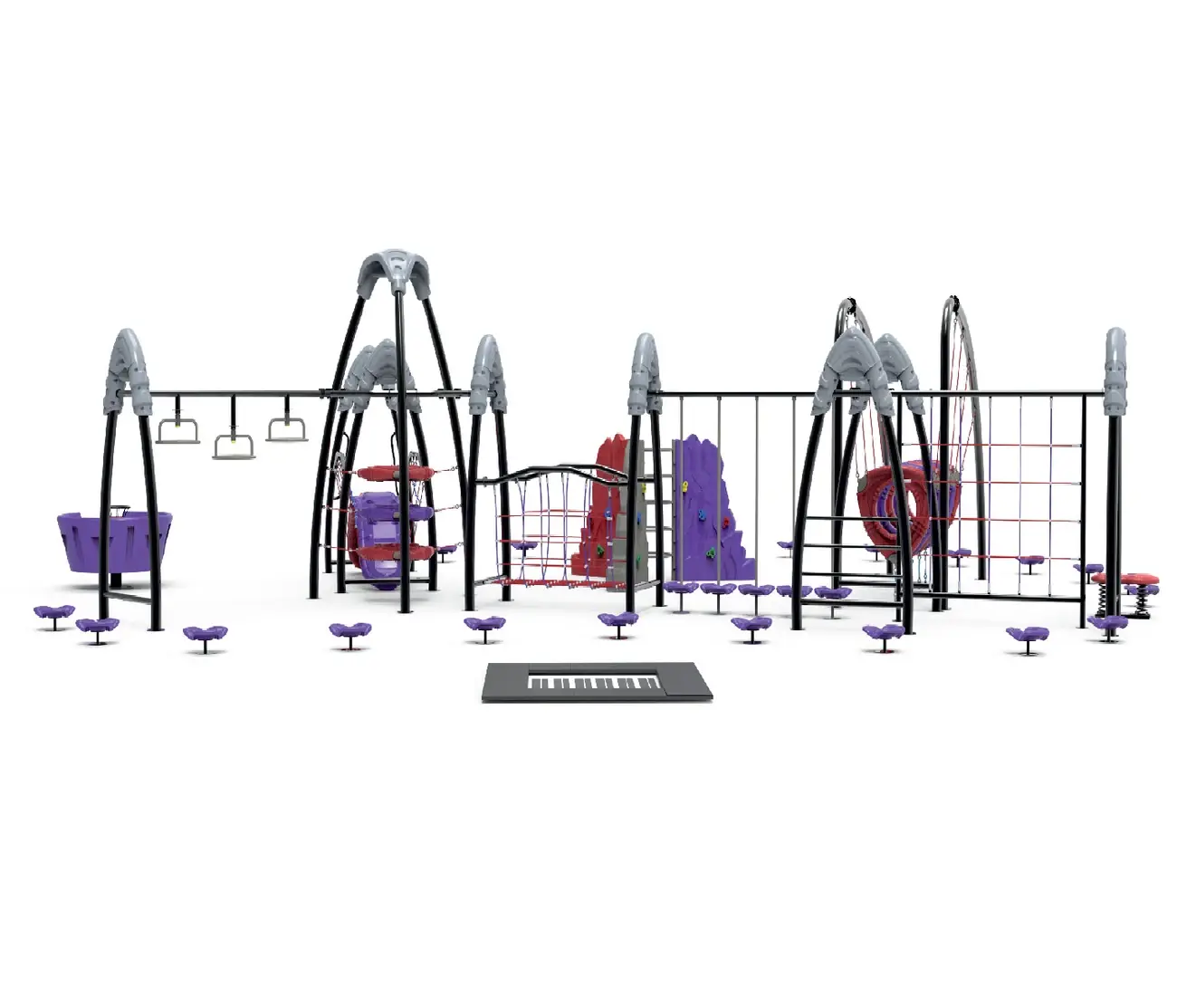
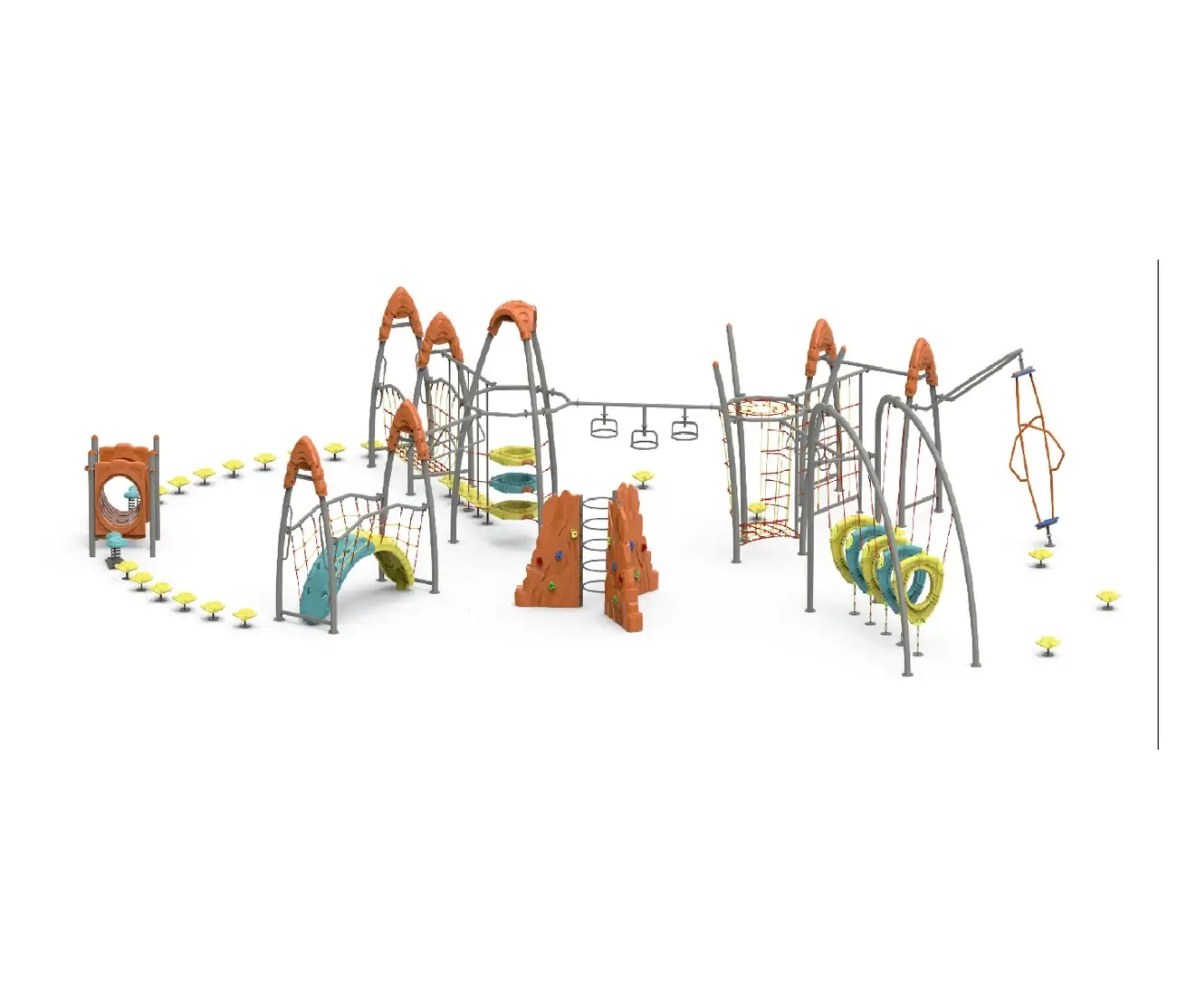
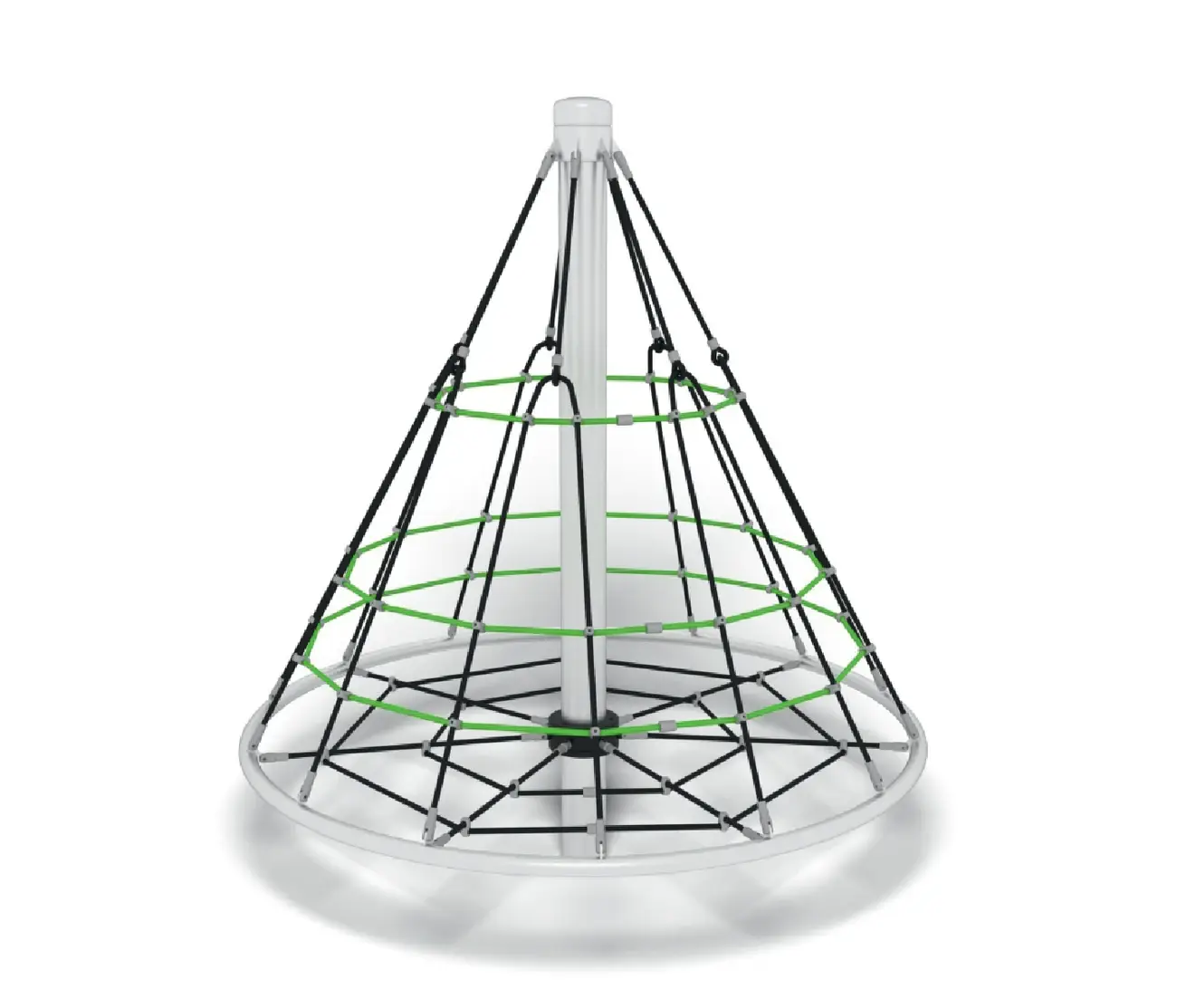
Rather than centring on a slide, the Survivor Series is built around climbing, balance and rope traverses across 5 courses. Rope nets, pyramid climbing faces, suspended platforms and balance elements are its components. Posts are electrostatically powder-coated steel and the ropes are steel-cored braided rope rated for outdoor use.
The series addresses children of six and over. At that age a simple slide holds no interest; children look for physical difficulty, speed and a way to measure themselves. Where a play area offers nothing for this group, they use equipment meant for younger children in ways it was not designed for — which is often where accidents start. Survivor courses fill that gap, typically in school grounds, youth centres, neighbourhood parks and campsites.
The series splits into two scales, and that split drives the choice. On the compact models (IP 05 and IP 06) the footprint is 200 × 200 cm and the safety area 400 × 400 cm — about 16 m² — with drop heights of 200–300 cm and a simultaneous capacity of 5–10 children. On the large courses the footprint runs from 1400 × 1400 cm to 1700 × 1700 cm and the safety area from 1800 × 1800 cm to 2100 × 2100 cm, roughly 324 m² to 441 m².
That range makes the series workable in both a small school yard and a park-scale site. In a tight space the compact climbing pyramid stands on its own; in a large one the course becomes a continuous route the child enters at one end and leaves at the other. Which scale is right depends as much on the number of simultaneous users expected as on the size of the site.
Drop heights run 200–300 cm, and they set the impact-absorbing surfacing requirement. On climbing courses the surfacing must be continuous across the whole safety area, not just under the structure: a child falling from a rope does not drop vertically but travels in the direction of movement. Flooring is therefore not a small detail alongside the equipment line. The courses fall under TS EN 1176, the standard for playground equipment.
In siting, the entry and exit ends of a course should not cross a pedestrian route, and its safety area must not overlap that of another unit. Allow for the swing of rope nets as well. For supervision, the course belongs in an open, fully visible position rather than an enclosed one.
Capacity is stated in the dimension table for this series: the compact models take 5–10 children at once. That figure can be used directly when working out how many pupils a site will serve. In short, intense periods such as a school break a single compact unit fills quickly, so school grounds should take either two units or one of the larger courses.
Maintenance differs here because the thing to watch is the rope: fibre breakage, opening of the braid, and wear at end fittings and clamps all need regular inspection. Alongside that, post anchors, the tightness of knots and connection points, and paint integrity are reviewed seasonally. Send us your site dimensions and target age range and we will work out which scale of course fits.
Survivor Climbing Courses dimensions
Published dimensions of 4 models. Site layout follows the safety area; the m² column is that area. Dimension tables for all series →
| Product Code | Model | Drop Height | Peak Height | Footprint | Safety Area | m² |
|---|---|---|---|---|---|---|
| IP-05 | IP 05 Climbing Course | 300 cm | 300 cm | 200 x 200 cm | 400 x 400 cm | 16 |
| IP-06 | IP 06 Climbing Course | 200 cm | 200 cm | 200 x 200 cm | 400 x 400 cm | 16 |
| SRV-01 | SRV 01 Climbing Course | 260 cm | 300 cm | 1700 x 1700 cm | 2100 x 2100 cm | 441 |
| SRV-02 | SRV 02 Climbing Course | 260 cm | 300 cm | 1400 x 1400 cm | 1800 x 1800 cm | 324 |